
Why AI is the Ultimate Sparring Partner for Real Science
AI is revolutionizing science, acting as a sparring partner for researchers. It helps spot patterns, solve complex problems, and accelerate discoveries, as seen with GPT-5 Pro in T-cell research.

Why AI is the Ultimate Sparring Partner for Real Science
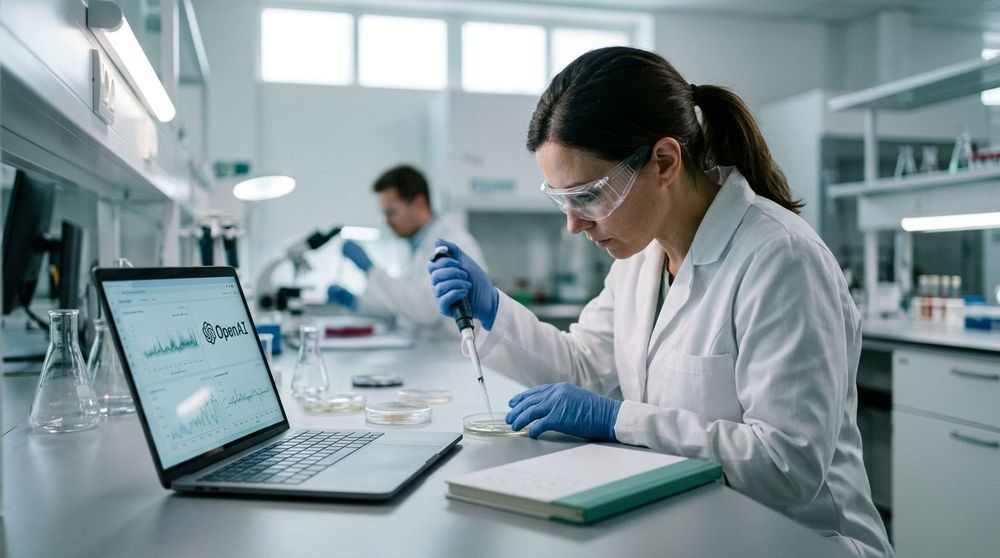
I am genuinely pleased to see the medical world embracing AI as a serious technology. We are finally moving past the hype and seeing what these tools can actually do. To me, this is not a gimmick. And let me be clear: AI is not here to replace human scientists. Instead, what we are seeing is the rise of a powerful sparring partner—one that helps researchers spot patterns faster, build better ideas, and reopen lines of inquiry that had reached a dead end.
Take a look at what happened at The Jackson Laboratory. Back in 2022, an immunologist named Derya Unutmaz and his team ran into a wall. They were studying T-cells, which are key parts of our immune system, to see how different environments affected their growth. They set up two scenarios: one with low glucose (sugar), and another using deoxyglucose, a molecule that mimics sugar but shuts down energy production.
The results baffled them. While both setups starved the cells of energy, the cells behaved completely differently. The low-glucose cells stayed quiet, but the deoxyglucose cells started rapidly producing inflammatory cells called Th17. The team could not explain why, so they eventually put the project on ice.
Three years later, they decided to hand this raw data over to GPT-5 Pro.
What happened next is exactly why I find this technology so exciting. The AI model quickly spotted a biochemical pathway that had escaped the researchers. It mapped out how deoxyglucose blocks the creation of a protein called IL-2. Normally, IL-2 acts like a natural brake to stop T-cells from turning into inflammatory cells. By blocking the brake, the deoxyglucose caused the surge of Th17 cells.
To make sure the model was actually using logic rather than just repeating memorized training data from the internet, the team ran a blind test. They gave it unpublished data from a completely different experiment involving cancer-fighting cells. The AI correctly predicted how those cells would behave. Because the paper was not yet online, the model had to figure this out using logical deduction, not search results.
What they have built here points to a new way of handling scientific discovery. Instead of spending years chasing dead ends, researchers can use these systems to automate the heavy lifting of reading papers and testing ideas.
The process generally follows four steps. First, the model reads a massive library of research papers. Second, it flags contradictions or gaps in the current studies. Third, it helps narrow down the best ideas to test. Finally, it runs simulations to predict how cells will behave, helping scientists figure out which physical experiments are actually worth running.
That said, the doctor, researcher, or scientist always remains responsible. Human verification is still essential to double-check the model's logic and make sure the biology holds up in the real world. For me, this is the right framing: AI as an accelerator of human expertise. The way knowledge is searched, combined, challenged, and validated is changing fundamentally.
Of course, accelerating biological research this quickly comes with obvious risks. The same reasoning tools that solve medical mysteries can also make it easier for bad actors to design biological or chemical weapons. To manage this, OpenAI uses a dedicated safety framework to monitor security limits and block dangerous queries.
At the same time, the corporate world is moving fast to adopt these tools. Samsung Electronics recently authorized its global workforce to start using ChatGPT Enterprise and Codex for technical tasks. However, intelligence agencies are also waving red flags. The Five Eyes alliance—which includes the US, UK, Canada, Australia, and New Zealand—warned that next-generation models will likely boost the speed and sophistication of cyberattacks in the coming months. In response, OpenAI has beefed up its defensive tools, launching security updates, a restricted cyber-defense model, and collaborative security projects.
Those risks—including AI "hallucinations" and security threats—are very real. Critical thinking remains absolutely essential. But reducing AI to only those risks is intellectually dishonest.
The real value of AI emerges when it is applied in controlled environments where expertise, data, verification, and accountability come together. In medical research, that is exactly where AI can make a difference: not by declaring the absolute truth, but by helping researchers arrive faster at hypotheses they can actually test.
We need more stories like this. They show us much more clearly where AI is heading: less magic, less panic, and a lot more concrete value.
Sources:
Related articles
Inside the Google Gemini 3.8 Live Avatar Architecture
Google's Gemini 3.8 Live Avatar lets enterprises build real-time digital personas. Inside the low-latency, neural rendering architecture behind it.


Accelerating Local Air Pollution Modeling with Earth-2 CorrDiff
Earth-2 CorrDiff uses AI to model air pollution faster and more accurately, enabling policy simulations, health alerts & local training. Open-source soon.

Microsoft AI Launches MAI-Transcribe-2
MAI-Transcribe-2: Microsoft's new ASR for audio-to-text. Faster, more accurate, 60 languages, code-switching, speaker diarization. Promo price $0.10/hr.