
Mistral Opens Munich Hub to Tackle Sovereign Risk and Industrial Computing
Mistral AI opens a Munich hub to help European industries build secure, physics-informed AI models and protect data sovereignty with open weights.
Copy, download or open this article in ChatGPT or Claude
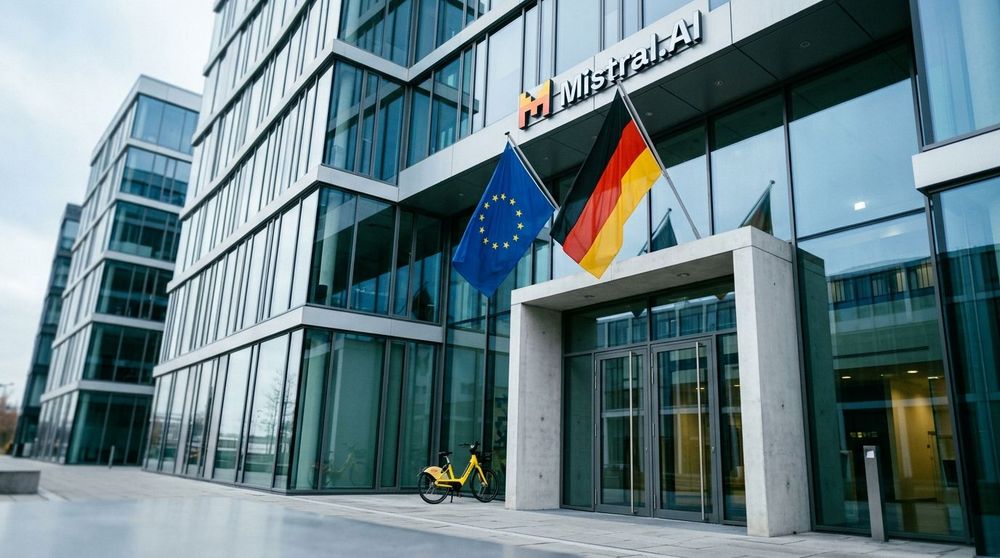
On September 28, 2026, European AI developer Mistral opened a new business hub in Munich, Germany. Located in the heart of Europe’s largest industrial economy, the facility is designed to help companies use their own proprietary data to build secure, localized AI systems.
For European enterprises, this expansion is a direct response to growing supply-chain risks. The European AI Forum and other industry groups have repeatedly warned that relying too heavily on foreign AI providers leaves domestic companies vulnerable to shifting export laws. Because AI models are becoming critical infrastructure for modern factories and utilities, building secure, local alternatives is increasingly vital for operational control.
Accelerating Engineering with Physics-Informed AI
A major focus of the Munich facility is physics-informed AI. Traditional heavy-industry simulations, such as structural stress testing in automotive crashes or thermodynamic modeling in energy grids, typically take days of high-performance computing. Incorporating physical laws directly into neural networks changes the equation, drastically cutting down these calculation times.
This capability is rooted in Mistral’s May 2026 acquisition of Emmi AI, which integrated a team of 30 physicists and research engineers specializing in structural mechanics and fluid dynamics.
Already, the Munich hub is putting these models to work through several commercial partnerships:
- BMW: Collaborating on AI-accelerated crash testing and structural engineering simulations.
- Siemens Energy: Co-developing applications optimized for heavy machinery.
- Airbus: Engineering custom systems under a multi-year agreement for aviation, space, and defense.
On the academic side, Mistral is partnering with the Technical University of Munich. Researchers are using the university’s wind tunnel to build real-time aerodynamic digital twins, fusing physical sensor data with predictive AI models to speed up forecasting.
Ultimately, the goal is to combine deep industrial expertise with raw AI power. For complex tasks like car crash simulations, simply having faster models is not enough. The real value comes when companies can link these systems to their own private data, their existing testing setups, and the everyday judgment of their experienced engineers.
Reducing Compliance Risk through Open-Weight Models
For corporate risk and compliance officers, relying on external, closed-source AI models introduces substantial compliance hazards. Sending proprietary operational data to third-party APIs can easily conflict with strict regional frameworks like the GDPR.
To bypass these data-sharing risks, Mistral’s Munich hub emphasizes an open-weight deployment model. By providing access to the underlying model weights, Mistral allows companies to host the systems on-premises or in secure private clouds. This setup ensures that sensitive telemetry and operational data never leave the customer's controlled network.
However, this focus on digital sovereignty still needs a real-world test. While open weights and local hosting give companies far more control over their data, they also bring new challenges. Businesses must still find ways to manage software connections, keep daily operations running smoothly, and make sure their entire AI system is easy to inspect and audit.
To support this architecture at scale, Mistral plans to build out one gigawatt of European-based compute infrastructure by 2030, keeping data processing firmly within domestic jurisdictions.
This focus on regional sovereignty has already attracted public-sector interest. On September 16, 2026, Mistral signed a letter of intent with the European Space Agency (ESA) to test models on secure, European-controlled networks for space exploration, climate science, and satellite engineering.
The project has also received strong support from government officials. Karsten Wildberger, Germany's Federal Minister for Digital Transformation, and Florian Herrmann, Bavarian State Minister, both welcomed the hub as a critical step toward keeping advanced computing research and specialized engineering talent within the region.
Looking ahead, specialized AI will likely first prove its worth inside existing engineering workflows. The big question is whether these tools can bring clear time savings while remaining reliable when dealing with situations they weren't originally trained on. For safety-critical designs, proving the AI is completely reliable will always matter just as much as speed.
Related articles
What the Cloudera–Mistral Deal Reveals About Europe's AI Future
Cloudera-Mistral deal highlights Europe's shift to sovereign, self-hosted AI for sensitive data, driven by new regulations emphasizing control & independence.

Capital Expenditure and Cluster Valuation
Enterprise AI demands huge capital for infrastructure, energy & hardware, plus smart software. Success hinges on holistic system management.


Credits are not infrastructure
OpenAI, WAN-IFRA and the Association of Independent Regional Press Publishers of Ukraine announced a newsroom AI programme on Monday.